Close this alert

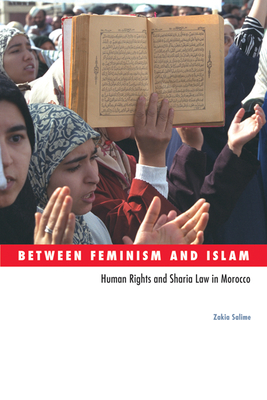
Between Feminism and Islam: Human Rights and Sharia Law in Morocco (Social Movements, Protest and Contention)
Current price:
$25.50
Publish Date:
Publisher:
Univ Of Minnesota Press
ISBN:
9780816651344
Pages:
248
Language:
English
Usually Ships in 1 to 5 Days
Description
There are two major women’s movements in Morocco: the Islamists who hold shari’a as the platform for building a culture of women’s rights, and the feminists who use the United Nations’ framework to amend shari’a law. Between Feminism and Islam shows how the interactions of these movements over the past two decades have transformed the debates, the organization, and the strategies of each other.
In Between Feminism and Islam, Zakia Salime looks at three key movement moments: the 1992 feminist One Million Signature Campaign, the 2000 Islamist mass rally opposing the reform of family law, and the 2003 Casablanca attacks by a group of Islamist radicals. At the core of these moments are disputes over legitimacy, national identity, gender representations, and political negotiations for shaping state gender policies. Located at the intersection of feminism and Islam, these conflicts have led to the Islamization of feminists on the one hand and the feminization of Islamists on the other.
Documenting the synergistic relationship between these movements, Salime reveals how the boundaries of feminism and Islamism have been radically reconfigured. She offers a new conceptual framework for studying social movements, one that allows us to understand how Islamic feminism is influencing global debates on human rights.
Praise for Between Feminism and Islam: Human Rights and Sharia Law in Morocco (Social Movements, Protest and Contention)
"Between Feminism and Islam challenges the common assumption in the media and the academy that Islamism and feminism are quintessentially opposed ideologies. Through a careful sociological and ethnographic account of Moroccan feminist and Islamist women’s organizations, Zakia Salime shows how the two have transformed each other through decades of activism, debate, and engagement. This is an indispensable book for sociologists of gender, religion, politics, feminism, the Middle East, and Islam." —Saba Mahmood, author of Politics of Piety: The Islamic Revival and the Feminist Subject
"The book is a wonderful study of religion, politics, feminism and the Middle East. "—Amos Lassen
"Salime’s examination is an irrefutably timely contribution to the study of social movements in North Africa and constitutes a crucial rupture in less discerning discussions of both feminist and Islamist social movements in the region. Contemporary fears about the cooptation of popular movements to the service of supposedly draconian Islamist-inspired social policy ought to be somewhat assuaged by Salime’s analysis. Her conceptualization of “movement moments” offers scholars a useful way to analyze movement histories, encounters, and exchanges. The salient position gender occupies in dialogues regarding nation-state citizenship, processes of democratization, and modernity continues to constitute a fruitful site to undertake this significant work."—Mobilization
"[Between Feminism and Islam] will make a lasting impact on the way that gender equality in Morocco is studied, because it challenges conventional ways of interpreting and understanding the relationship between the liberal feminist and Islamist movements."—The Cantaloupe Tales blog
"A thoughtful and detailed sociological analysis of two decades of women’s activism in Morocco, this book is an engaging work of scholarship, particularly useful for those studying social movements, gender politics, feminism, Islam, and the Middle East."—Anthropos
"Zakia Salime’s Between Feminism and Islam: Human Rights and Sharia Law in Morocco makes a particularly valuable intervention in the study of social movements."—Feminist Formations
Other Books in Series
The Rise of the Ku Klux Klan: Right-Wing Movements and National Politics (Social Movements, Protest and Contention #32)
Paperback
Out in Africa: LGBT Organizing in Namibia and South Africa (Social Movements, Protest and Contention #38)
Paperback

Globalization From Below: Transnational Activists And Protest Networks (Social Movements, Protest and Contention #26)
Paperback
Unraveling the Garment Industry: Transnational Organizing and Women’s Work (Social Movements, Protest and Contention #27)
Paperback

Contested Citizenship: Immigration and Cultural Diversity in Europe (Social Movements, Protest and Contention #25)
Paperback

The Politics of Social Protest: Comparative Perspectives on States and Social Movements (Social Movements, Protest and Contention #3)
Paperback
Rhyming Hope and History: Activists, Academics, and Social Movement Scholarship (Social Movements, Protest and Contention #24)
Paperback
Routing the Opposition: Social Movements, Public Policy, and Democracy (Social Movements, Protest and Contention #23)
Paperback
Identity Work in Social Movements (Social Movements, Protest and Contention #30)
Paperback

How the Religious Right Shaped Lesbian and Gay Activism (Social Movements, Protest and Contention #31)
Paperback
Strategies for Social Change (Social Movements, Protest and Contention #37)
Paperback
Repression And Mobilization (Social Movements, Protest and Contention #21)
Paperback
The World Says No to War: Demonstrations against the War on Iraq (Social Movements, Protest and Contention #33)
Paperback

Fighting for the Future of Food: Activists versus Agribusiness in the Struggle over Biotechnology (Social Movements, Protest and Contention #35)
Paperback
Strategic Alliances: Coalition Building and Social Movements (Social Movements, Protest and Contention #34)
Paperback

Solidarity And Contention: Networks Of Polish Opposition (Social Movements, Protest and Contention #18)
Paperback

Restructuring World Politics: Transnational Social Movements, Networks, And Norms (Social Movements, Protest and Contention #14)
Paperback
Challenging Authority: The Historical Study Of Contentious Politics (Social Movements, Protest and Contention #7)
Paperback

Protesting Culture and Economics in Western Europe: New Cleavages in Left and Right Politics (Social Movements, Protest and Contention #41)
Paperback