Close this alert

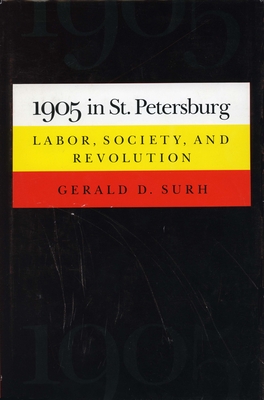
1905 in St. Petersburg: Labor, Society, and Revolution
Current price:
$95.00
Publish Date:
Publisher:
Stanford University Press
ISBN:
9780804714990
Pages:
504
Language:
English
Usually Ships in 1 to 5 Days
Description
This account of the St. Petersburg labor movement during the First Russian Revolution focuses on the sources and meaning of the extraordinary explosion of labor militancy in 1905 - a year that saw more striking workers than ever before in Russian history, almost a quarter of them in the capital. In contrast to earlier works, which have explained this militancy by stressing the political leadership of the Social Democratic party, the author offers a more complex and balanced picture that takes account of not only the moderate sectors of the opposition, but the initiative of the workers themselves. Situating the labor movement within the social and political ferment of early-twentieth-century Russia, he analyses the reshuffling of relations between workers and the intelligentsia that stood at the gateway of the entire revolutionary period. The result is an account of the revolution that takes a fresh look at the interaction of workers, the educated opposition, and the revolutionary parties, yielding a new appreciation of the role of each. The analytical narrative on 1905 is preceded by several chapters establishing the precedents for the mass strikes that erupted in that year and documenting the long- and short-term reasons for the workers' rapid turn to political protest. The study treats both the indispensable contribution of the revolutionary parties to the political education of the Petersburg labor force and their failure to reach the vast majority of workers. The great events of 1905 itself are framed and elucidated from a number of vantage points in detailed studies of strike actions and worker leaders, factory and union organizing initiatives, liberal overtures to the labor movement, and the incipient and actual breakdown of public order in the capital. The narrative culminates in the October General Strike, when workers organized the first Soviet of Workers' Deputies, a unique fusion of their own autonomous militancy with the ideas and leadership of their socialist and liberal allies.
Other Books in Series
Peasant Metropolis (Studies of the Harriman Institute)
Paperback

Scenarios of Power: Myth and Ceremony in Russian Monarchy from Peter the Great to the Abdication of Nicholas II - New Abridged One-Volume Edition (Studies of the Harriman Institute)
Paperback
The Post-Soviet Nations: Perspectives on the Demise of the USSR (Studies of the Harriman Institute)
Hardcover

Holy Fathers, Secular Sons: Clergy, Intelligentsia, and the Modern Self in Revolutionary Russia
Hardcover

Mayakovsky: A Poet in the Revolution
Hardcover

Ruling Russia: Politics and Administration in the Age of Absolutism, 1762-1796
Paperback

Reforming Rural Russia: State, Local Society, and National Politics, 1855-1914
Paperback

Autobiographical Statements in Twentieth-Century Russian Literature
Paperback

Iuzovka and Revolution, Volume I: Life and Work in Russia's Donbass, 1869-1924
Hardcover

Iuzovka and Revolution, Volume I: Life and Work in Russia's Donbass, 1869-1924
Paperback
Moscow Workers and the 1917 Revolution: Studies of the Russian Institute, Columbia University
Paperback

The Road to Bloody Sunday: The Role of Father Gapon and the Petersburg Massacre of 1905
Paperback

Soviet Perspectives on International Relations, 1956-1967
Paperback

Mayakovsky: A Poet in the Revolution
Paperback

Oblomov and His Creator: The Life and Art of Ivan Goncharov
Paperback
Revolution of the Mind (Studies of the Harriman Institute)
Hardcover

Iuzovka and Revolution, Volume II: Politics and Revolution in Russia's Donbass, 1869-1924
Paperback
Technology and Society Under Lenin and Stalin: Origins of the Soviet Technical Intelligentsia, 1917-1941
Paperback

Ilya Repin and the World of Russian Art (Studies of the Harriman Institute)
Paperback

The Soviet Academy of Sciences and the Communist Party, 1927-1932
Paperback